In and Against the System: with Dr. Carolyn Whitzman
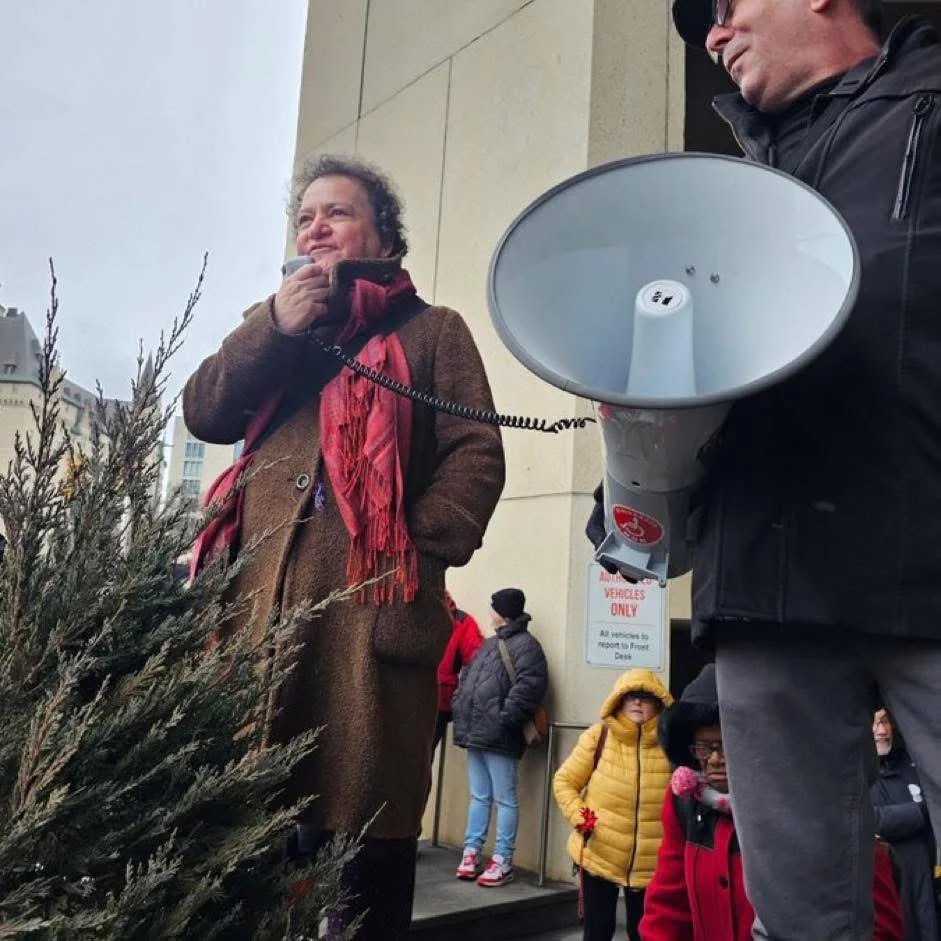
Dr. Whitzman in action at a community event in 2024. Photo provided by Carolyn Whitzman.
Introduction
Dr. Carolyn Whitzman is one of Canada’s most respected housing researchers and urban thinkers: an Adjunct Professor at the University of Toronto’s School of Cities, former professor of urban planning at the University of Melbourne, and a long-time advocate for women’s safety, equity, and the right to the livable city. Her career spans municipal government, academia, international research networks, and community activism—giving her a rare vantage point on how Canadian housing systems function, and why they so often fall short.
Here, Dr. Whitzman speaks with Dr. Bita Jamalpour about the challenges of working “in and against the system,” the roots of exclusion in planning, the limits of zoning, and the structural shifts needed if Canadian cities are to rebuild themselves around dignity, belonging, and the public good.
Bita: Thank you for making the time, Carolyn. Before writing, you spent years inside municipal systems and saw how “good” policies can still fail low-income residents, women, and marginalized groups. Why does a profession that claims to build better places keep repeating these exclusions — and how do we keep faith while trying to change the story?
Carloyn: Such a good and difficult question to start with! My entire PhD thesis (published as ‘Suburb, Slum, Urban Village’ in 2008) was about how planners have been better at shutting down low-income housing options than at enabling adequate affordable housing. This has been true over time: row houses, apartment buildings, rooming and boarding houses, conversion of older houses to small studio apartments, supportive and public housing – all opposed in one Toronto neighbourhood of Parkdale over 125 years – and every time using poor people’s health and ‘morality’ as an excuse.
But there have been moments of state-led good practice in Toronto: St. Lawrence Neighbourhood in the 1970s, Cityhome public housing in the 1980s, conversion of city-owned parking lots to nonmarket housing now.
The only solution I can see is rights-based targets and working backwards from them: how many homes of a certain size in a certain location at a certain cost are needed?
As for individual hope for systems change, I guess optimism is the only alternative to despair. And it is important to recognize victories.
Bita: Do you think that the disappearance of middle-income housing - rental apartments, co-ops, modest condos - is a policy failure rather than a market outcome? And if so, how do you think policy has failed? By ignoring the right people and missing the real housing targets?
Carolyn: Absolutely, but I wouldn’t create a dichotomy between “market failure” and “policy failure.” It’s both, and it’s bigger than that. It’s a failure to grapple with the realities of people’s lives. Right now, a majority of low-income people are spending 50-70 percent of their income on basic needs like housing. There’s no money left for anything else.
Market providers can deliver low-income housing, but when you compare what a low-income household can actually pay with the lowest so-called “affordable” rents available, the gap tells the whole story.
We need to use evidence to confront gaps in our policies and programs. And it’s not only low-income households anymore — middle-income people are now facing exactly the same pressures. In the early 1990s, rents were affordable; home ownership was affordable. Today, home ownership is possible only for the top 20 percent, and renting is becoming affordable only for higher-income households.
“It started with poor people, and it percolated up.”
Bita: I’ve followed your work for years, and I can hear an evolution in your voice — from the early outraged practitioner, to the historian-witness of Suburb, Slum, Urban Village, to the later writer who is clear-eyed yet never cynical. Through it all, your core message feels constant: cities tell stories about who belongs, and unless we rewrite those stories, no amount of building will make them fair. Is that a fair reading of your work?
Carolyn: That is a very fair summary, beautifully put. I think I’m still an outraged practitioner! But maybe more dug in for the long haul.
In the 1980s, when I started writing, I was informed by 1970s feminism. A lot of good change happened over those decades – in terms of greater access to divorce, abortion, jobs (especially if you were white and well-educated – for me, at least, intersectionality was in its infancy).
I’m still appalled by high and growing levels of gender-based violence. And the affordable housing situation has gotten so much worse. I think I’m still a questioner of rules – if zoning doesn’t work (and it really doesn’t, and I didn’t even comprehend its full racist origins in the 1980s, although Mariana Valverde’s 1991 book ‘The Age of Soap, Light and Water’ certainly helped), then get rid of it.
Bita: Getting rid of zoning! — and with it, all the patriarchal, racist, and anti-feminist inheritance that comes from the old boys’ club of planning. What would that actually look like in practice?
Carolyn: Yes, zoning has patriarchal, racial, and class structures baked into it, and they’ve been perpetuated for a century. Getting rid of zoning is the right instinct, but the real question is: what do you replace it with?
We need to think in terms of different kinds of land. Government land — which we so often sell off to market landlords so they can build stadiums and expensive apartments — could be used for social housing, like Vienna. Private land, which is the majority in Canadian cities, points toward performance- or form-based planning, but that still doesn’t address social issues.
I’m honestly not sure yet what fully replaces zoning, but it needs to be flexible. It needs to allow smaller family homes, congregate homes, seniors’ housing, and all the other forms we’ve shut out. It should be mixed-use by default. Japan has 13 zones; Ottawa has 120 residential zones alone — the balance is totally off.
We could move to nuisance-based zoning, where you regulate proximity to industrial or noisy uses rather than people. Zoning has done more harm than good. We need flexibility and an organic approach to city growth. Remember, Canada had self-built housing until World War II. Informal communities have their own challenges, but they also show what’s possible.
“Zoning has done more harm than good. We need flexibility and an organic approach to city growth.”
Bita: Today’s cities seem to tell a very different story. They increasingly favour power, those with more money, more land, more leverage. Planning systems, once meant to balance those forces, now often amplify them. Do you think that’s inevitable in how cities evolve, or is it the result of specific policy choices we’ve made about who gets to belong?
Carolyn: It’s absolutely the result of choices — individual champions matter, and systems aren’t inevitable. Even during the neoliberal turn of the 1980s, cities like Vienna and Singapore continued strong housing policy, though they weren’t perfect. There have been transformative changes in Paris and Montréal under female political leadership. And planners like Janette Sadik-Khan in New York were politically empowered to make real change.
As planning theorist Beth Moore Milroy reminded us, no city is perfect. We need to celebrate what works while acknowledging what doesn’t. And trajectories are never simple.

Award-winning housing development with interior facing balconies in Copenhagen. Photo taken by Doolin O’Reilly.
Bita: You mentioned those meaningful changes under female leadership. How were they different? In many Canadian municipalities, we’re overwhelmed by regulations — plans, bylaws, zoning. Even the most progressive leaders seem constrained by the system. What can local governments and planners realistically do to be more than passive players?
Carolyn: Planners can be more than passive players when they see themselves as change agents inside the system. People who work with marginalized communities often don’t call themselves change agents, but they are. When I worked for the City of Toronto, I sometimes got into trouble for challenging the status quo. You have to talk to the right politicians, bring evidence, and push respectfully and consistently.
The reality is that most planners are overwhelmed with bylaws, reports, council meetings. It limits how bold they can be, and the ability to challenge systems is often tied to personal security — not everyone has the same room to take risks.
So the work becomes: use what you can influence. Evidence. Relationships with councillors. Collaborations with advocates. Small but steady shifts in how tools are interpreted. That’s how structural change happens from within.
“Planners can be more than passive players when they see themselves as change agents inside the system.”
Bita: In Home Truths, you call—unapologetically—for a return to public housing, using history as moral evidence and writing from lived experience rather than theory. You’re clear-eyed but never cynical, which is rare in our field. You’ve stepped outside the system to tell the truth about it; I’m still inside it, trying to keep faith. Many of us are. How do we work from these two sides of the same wall?
Carolyn: Ha! Good question! Even in the little sheltered workspace I’ve consciously created over the past few years, as a sole practitioner consultant with no real boss and no real employee, I still have to make my clients happy. And I don’t like to enter into a discussion – whether it is a bunch of private sector developers, or investors, or the federal government – with a blowtorch. I do try to tell my evidence-based ‘truths’ while being a respectful listener.
I feel like I was able to do this as a civil servant as well, although it was a different time (1989-1999).
Bita: So you’re saying it’s about speaking the truth with respect — using facts, not fire — and finding ways to create change from inside the system. In a system so tied to regulations and procedures, not the organic, people-centred way cities used to grow, what advice would you give a planner trying to make a real difference?
Carolyn: I understand how hard this is. There are so many restrictions on what can be said publicly. Some people go along with the dominant narrative because they need to keep their jobs and support their families.
It’s funny when I share opinions and articles on LinkedIn. People in some federal agencies who are in senior roles are scared to engage with anything political I post; they’ll ignore the criticism about housing but happily like the posts about my cat.
We’re scared to voice real concerns. In Canadian culture especially, people are conservative about what they’ll say out loud. When I moved into academia, I was warned I’d get pushback, but after years in bureaucracy, it didn’t faze me.
Now I’m like a “mom of bureaucracy.” I confront people about what they’re doing, but I also try to understand where they’re coming from. Some are tied to political parties, some have impossible bosses. If you respect their space, they’re more likely to come back to you. And honestly, I genuinely like many of the people I work with.
And yes — I am getting to the point of not giving a shit about what other people think of me, and it is liberating.
Bita: Through your work, I’ve come to see housing as a kind of mirror, and what it reflects these days is not flattering. A country that once treated homes as part of the social contract now treats them as speculative assets. One of the wealthiest nations in the world, yet hundreds of thousands unhoused and millions struggling just to stay housed. You’ve written that it’s not capacity we lack, but moral clarity.
Do you see that moral failure as national and structural? Can a crisis of this scale really be fixed through local zoning reforms, or does the federal government carry the deeper responsibility? And for those of us in city halls, living with the consequences every day — how do we keep working with integrity inside a system whose real levers sit far above us?
Carolyn: Absolutely, it is a national, structural issue. France downloaded housing to its regions in the late 1980s, and stepped back in, appalled, in 2000. Canada got plenty of warning that downloading affordable housing to provinces in the early 1990s (which provinces said they wanted) was going to lead to a homelessness disaster but Chretien and Martin kept Mulroney’s neoliberal agenda going despite all evidence that we were headed towards a homelessness iceberg.
Editor’s note: “Downloaded housing” refers to the national government shifting responsibility for housing to lower levels of government without transferring sufficient funding or capacity.
All levels of government have failed. Provinces haven’t increased social assistance in line with inflation since the 1990s and have eroded tenant protections and health and social services. They are the level of government most directly responsible for homelessness. Cities also bear responsibility – they were increasingly exclusionary, increasingly reliant on trickle-down from big private developers (inclusionary zoning, development taxes) and they accepted ridiculous levels of sprawl without the capacity to pay operating costs for the resultant infrastructure. It is hard to work for any of these lying losers!
But I’ve seen planners make a difference – in Edmonton, Kitchener, Montreal. Politicians need to pick up what we are putting down, but we need to provide evidence-based advice fearlessly.
Bita: When you say planners “made a difference,” what did that look like?
Carolyn: We need more grassroots interventions and conversations. We need more work on policy analysis, and every once in a while there is an impact — like redefining affordability or homelessness metrics.
Talking to the media is liberating — I have a journalism background. I don’t work for government anymore, so I can say what I think. Inside government, you were constantly confronted with “who says you know better than an architect about setbacks?” There’s a lot of reluctance to give up control. A lot of people think they know better, and sometimes you end up with people who couldn’t get the right job elsewhere coming to the city and imposing ideas that are less informed.
We’re still using design guidelines from 20 years ago, even though everyone knows they don’t work. I remember consultations about Housing First 25 years ago — how long do you have to consult before you feel you’ve adequately consulted?
People in EDI work are constantly questioned because they can’t produce perfect numbers. Homelessness measurements don’t actually measure homelessness. It is imperfect — but we have to work with it.
Bita: Let’s bring that question down to practice: If you were a planner today, inside local government, working under political pressure, housing targets, and feasibility constraints, what would you do differently? How can you use the limited authority you have - through approvals, negotiations, and policy design - to shift a system still built around speculation and exclusion?
Carolyn: Hahaha, that reminds me of a question I was asked for a CIP (Canadian Institute of Planners) exam in 1996 on why planners need to be objective and I said ‘nonsense, planners are never objective’. I recently spoke to a very powerful planner in a new position and asked them how they planned to act as a ‘change agent’. And that person was shocked. And I was shocked that that person was shocked.
I would be advocating for relaxed, performance-based zoning, a move towards transparent, income-based targets, and I’d be listening to what non-market and market affordable housing developers and providers had to say about making their lives easier. I’d be reading and getting support from my peers in other cities.
I would be working behind the scenes for change, in and against the system. And hopefully, not getting punished for it.
Bita: On discretion and truth-telling: how do you work “in and against the system”?
Carolyn: Well, for me, working in and against the system means calling out the parts that don’t make sense while still using the tools we have. And there are examples.
The group that everyone agrees needs housing help is single mothers. But trying to calculate neat proportions of units for them is counterintuitive — what we really need is to build the housing first and sort out the tenancy mix later. We shouldn’t be restricting housing based on family type.
Indigenous people are at particularly high risk of homelessness. Redlining happened here just as much as in the U.S. And our “family-friendly unit” definitions are far too rigid for the realities people live in. Those are the kinds of places where you push back.
And then there’s density. The arguments get wrapped up in elections, and guidelines on height or unit limits end up as symbolic battles instead of real planning tools. That’s another place where you have to question the system from within.
Bita: Here that I work, in British Columbia, we’ve seen rapid regulatory change: inclusionary housing, parking relaxations in transit-oriented areas, adjustments to development cost charges, the introduction of small-scale multi-unit zoning, …. Do you think these reforms mark real progress, or are they technocratic gestures inside the same moral framework?
Carolyn: I think BC’s gone further faster than other provinces. It listened to the non-market sector while developing affordable housing policy, which is good. And the proof is in the pudding: rates of supportive and non-market housing completions that are three times higher than the rest of Canada.
The building code reforms and zoning reforms are still in the process of influencing non-market and market development, but they are a good start. Municipalities are still throwing in poison pills – from minimum setbacks to development charges – that mute the impact of good reforms, in my opinion.
I find it fascinating that Indigenous-led development in Vancouver – Senakw, Jericho and Heather Lands- is some of the best in Canada, which wouldn’t be possible without settling land claims.
Having said that, BC still isn’t following the golden housing policy rule: ask ‘who needs what housing where and what cost’ and then enact the policies that will enable those outcomes. Their social and health supports are still lacking and taxation policies still aren’t truly progressive.
So tldr (too long; didn’t read): better than mere technocratic gestures, still needs more progress. A hell of a lot better than the alternative.
Bita: When you talk about municipalities adding “poison pills,” do you see that as coming from technical misunderstanding, political caution, or resistance to losing control?
Carolyn: A lot of it is resistance to giving up control. Many people in city halls think they know better, even when the evidence shows otherwise. Market developers are usually the loudest voices; they support certain politicians and there's corruption in the mix.
High-rise buildings in Ottawa were not necessarily near good public transit — so what was the logic? It felt arbitrary. We need mixed density everywhere, not just in a few places. And most of the time it’s still dependent on the developer; there’s no non-market housing targets, nothing structural.
Canada likes to believe it’s morally superior, but it has its own problems.
Bita: I also want to ask about something quieter but equally worrying us in WIUC. In 2023, many of us were deeply engaged in EDI, JEDI, and gender-based analysis. As the housing crisis has intensified, that work has faded. We’ve started treating equity and housing as separate - sometimes even competing - priorities. But the housing crisis is the failure of equity. When we stop applying gender and equity analysis, we stop seeing who the crisis is crushing - and why.
How do you respond to that tension; the idea that EDI and GBA+ are “luxuries” when they may, in fact, be the only way to build the right kind of housing?
Carolyn: Wow, I feel like I’m part of the problem. I feel like I have a single-minded focus on numbers: rents, evictions, new supply, preserving affordable supply. I sometimes feel like equity-based sub-targets become a form of weasel numbers, especially when they are process-focused (‘we talked to experts of lived experience – yay, us! Mind you, we didn’t DO anything’).
We need to scale up non-market housing. And I want to throw everything at it, but the fact is that only some big non-market developers will be able to scale up housing. So we need to encourage partnerships with Black-led community land trusts and support For Indigenous by Indigenous Housing through land back – and encourage housing for single moms and those affected by gender-based violence and older women and LGBTQI+ folks as part of a partnership approach.
I think we need to monitor outcomes for groups that are particularly marginalized while realizing that endless carving of a small piece of the pie is much less productive than getting much more of the housing pie.
Bita: Numbers and stories — both matter. Why is it so hard to turn stories into measurable systemic outcomes?
Carolyn: When you don’t count the basic things properly, the whole structure falls apart. We’ve spent decades focusing on the wrong metrics and the wrong terminology. Homelessness counts don’t actually count homelessness. We’re carving tiny slices of a tiny pie instead of making the pie bigger.
This is imperfect work — it has to be iterative. We need to work with what we have for a while before changing everything again.
Bita: I also want to talk about the politics around density - something every planner, and every council, seems to wrestle with!
Across cities, debates about height and density often turn political, shaped by narratives about “greedy developers” on one side and “neighbourhood character” on the other. Inside council chambers, the arguments sound familiar: worries about unit sizes, shadows, traffic, or the loss of what’s often called the Canadian dream — a detached home with a yard. And behind those debates, there are legitimate concerns too: residents who feel we’re adding people faster than we’re adding schools, clinics, parks, or community spaces.
Do you think people are right to be afraid of density?
Or are we failing to show them what density can be when it comes with real investment in public life — in schools, services, and social infrastructure?
And how do we respond to elected officials who keep defining “livability” in terms of low density and private space, even as the public realm becomes more unequal?
Carolyn: I think my views have remained consistent over all parts of my life and career. I think cities are about density, diversity and complexity- full stop. I think that economically, socially, in terms of individual and collective health and environmental resilience, we need to densify much more quickly and comprehensively (suburbs as well).
By that, I mean 4-8 storey mixed use buildings everywhere with shared green space, linked to jobs and services through frequent, rapid public transit (and walking and cycling and other forms of sustainable mobility). Higher buildings anywhere near public transit. No unit limits. That is the only way, in the long term, we can collectively afford nearby schools, services and social infrastructure.

Nursing home with unconventional balconies in Copenhagen. Photo taken by Doolin O’Reilly.
Bita: How do we reconcile that — the vision of gradual, people-centered density with the market pressure for vertical, high-profit development?
Carolyn: Density arguments are inevitably politicized, especially during elections. Councils lean on “livability” arguments that often mean protecting low-density areas. But the real failure is that we haven’t balanced density — we’ve made it possible only in certain places.
Developers shape the outcomes because municipalities don’t have inclusionary requirements or strong public tools. Mixed density everywhere is the real solution. But we’re still stuck in the mindset of drastic height jumps instead of steady, predictable intensification.
Bita: And maybe to end on a personal note: after so many years of studying and challenging these systems, what still gives you hope? What keeps you believing that cities — built as they are in favour of power and profit — can still be reclaimed for belonging, fairness, and care?
Carolyn: Cities can be glorious – colourful and diverse. You can hear birdsong when there isn’t endless noisy car traffic. I love staring out my office window and seeing kids and dogs and people saying hi to one another. And I don’t live in Sesame Street! Just in an urban neighbourhood that works, with a lot of non-market housing in it.
I continue to be inspired by the younger generation and I want to be a good ancestor.
Bita: That’s such a beautiful way to put it; being a good ancestor. It brings us back to why we plan and build in the first place. Any closing reflections?
Carolyn: Being asked these kinds of questions makes me feel old — people want my oral history now! It’s flattering, and a little funny. Women Plan Toronto was a lifeline for me. I lived through misogyny in my master’s degree. I was active in the Women’s Planning Network in Australia and co-wrote a history of women in Melbourne planning in 2008. We just celebrated the 30th anniversary of that network — I’m part of history now.
Groups like WIUC matter — keep up the work. History is more cyclic than linear, including feminist history. I’m depressed by the violence against women, but we’re better at naming it now.
I think back to the Gender Inclusive Cities project, funded by UN Women from 2009-2011 — women speaking in four languages, Spanish and Swahili speakers understanding each other. It started with women in their 40s and 50s and ended with women in their 20s taking over. That’s what being a good ancestor is — generational shifts, not perfection.
We’re trapped in our mindsets and problems. We need to change our point of view.
Bita: Thank you so much, Carolyn, for sharing your honesty, wisdom, and hope with us.
Note: This dialogue reflects Dr. Whitzman’s professional perspective, informed by long-standing research and experience in housing policy. The discussion is interpretive and not intended as a comprehensive statistical analysis.