Walking Together for Feminist Cities: WiUC in Conversation with Jane’s Walk Toronto
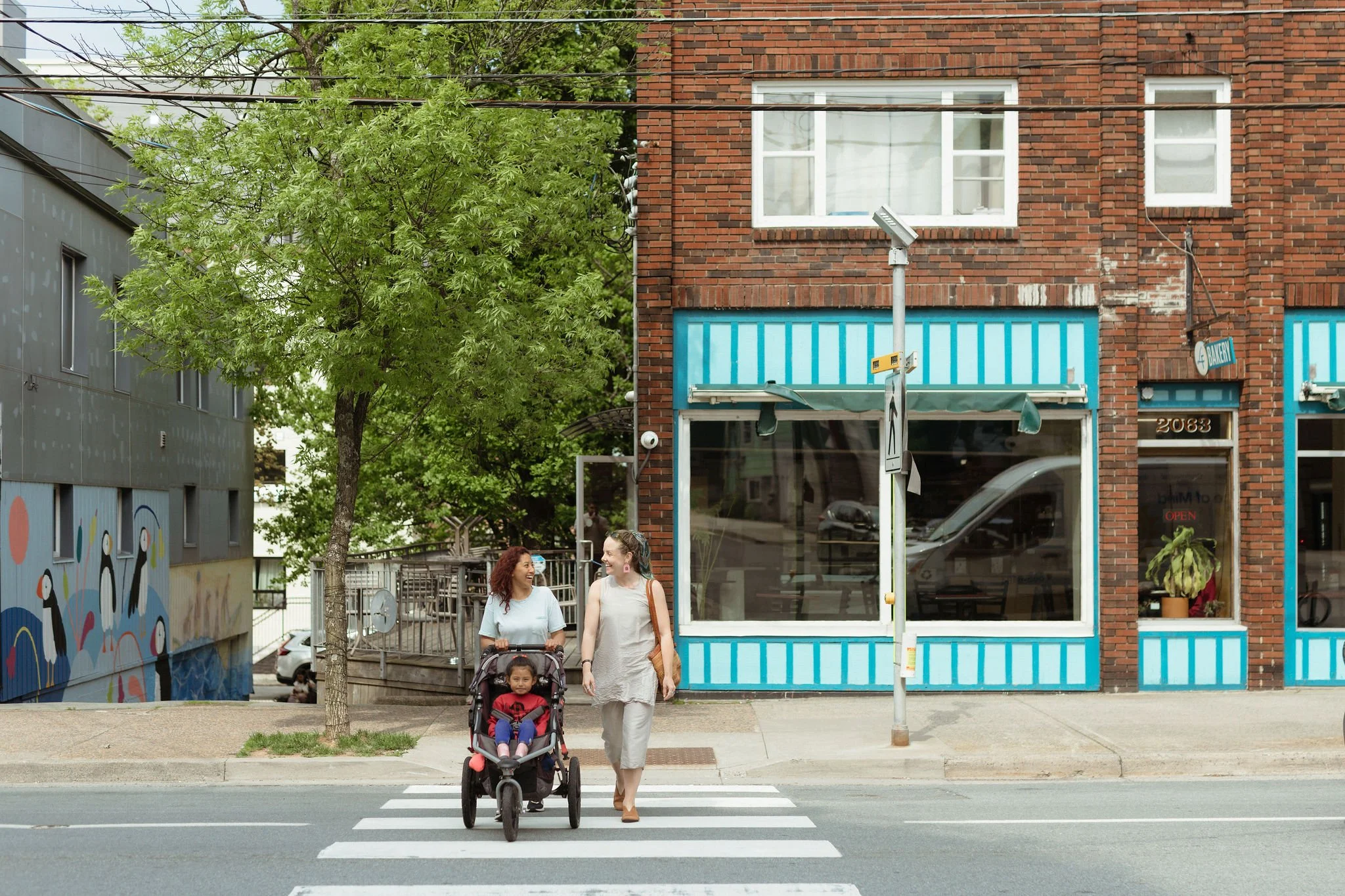
Two women crossing the street, with one of them pushing a stroller with a child. Photo taken by Alexa Cude at Halifax, NS.
It is that time of the year again when the city gets animated with small and large groups of people from different backgrounds and ways of life coming together to see familiar spaces anew. Parks, sidewalks, bridges, and alleyways are woven into stories that are finally told out loud and appreciated by many. That’s Jane’s Walk Festival, an annual event that features a series of volunteer-led walking tours that reimagine our everyday spaces, inspired by the urbanist and visionary, Jane Jacobs.
Ahead of this year’s festival, Firdous Nizar, Project Coordinator at Women in Urbanism Canada, sat down with Alejandra Fajardo, Communications and Engagement Specialist at Jane’s Walk Toronto Steering Committee to talk about what it means to carry and lead Jacob’s legacy forward on a local and global scale. We also discussed what it looks like when cities are actually designed for women and gender-diverse people so they could walk freely, gather openly, and have a sense of belonging.
The conversation shared here is a snippet of the vibrant discussion we had on various topics related to walking and urbanism. While this comes as no surprise, we quickly realized that our organizations have many overlaps and our work has more in common than we previously imagined. The three main themes that emerged were: (1) the work we do as organizations and why we do it, (2) our approach to safety, mobility, and who gets to occupy and take up space in the cities, and (3) the gaps we see and the hopes we have in addressing them.
On the work we do, and why
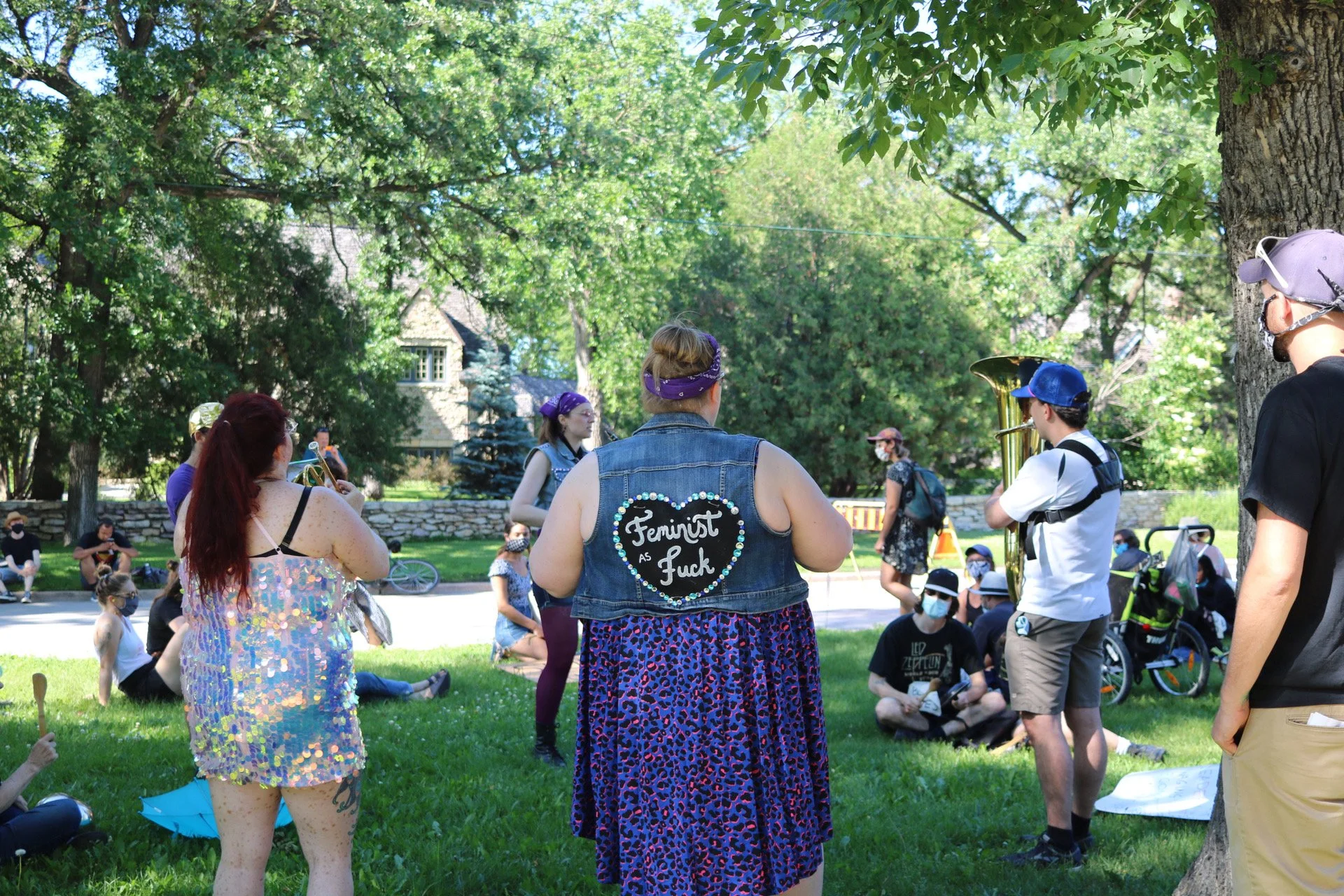
Feminist as Fuck marching band (FAF) performing at a park. Photo taken by Nicole Roach at Winnipeg, MB.
Both WiUC and Jane’s Walk as organizations exist because we believe cities are shaped by who gets to participate in shaping them. But the work itself can take many forms from festivals, walks, and gatherings to research and advocacy. This conversation starts with how each of our organizations show up, and what brought us to this work in the first place.
Firdous: When we hear Jane’s Walk, we hear Jane Jacobs and the impact she has created in inclusive urban design. How does your organization continue her legacy?
Alejandra: For us, continuing Jane Jacobs’ legacy starts with keeping the city in conversation. Jane’s Walk is about paying attention to everyday life, valuing local knowledge, and trusting that the people who live in a place are experts in it. In Toronto, this means creating space for residents, organizers, artists, advocates, and neighbours to share stories about their streets, parks, and public spaces.
Sometimes these walks help people reconnect with their neighbourhoods or with each other. Other times, they spark important conversations, surface concerns, or generate new ideas that might otherwise go unheard or unshared. We try to keep the festival open, accessible, and people-led, so it remains rooted in curiosity, care, and collective learning.
It often feels like we are opening a door, or a phone line, for people to speak, listen, and become more active members of their communities. In many ways, this approach reflects the kind of city-making Jane Jacobs championed, one grounded in observation, participation, and everyday voices.
“It often feels like we are opening a door, or a phone line, for people to speak, listen, and become more active members of their communities.”
That image of opening doors and phone lines for community members captures something we recognize and value at WiUC too. Our work begins from a similar instinct that a more equitable city starts with breaking the barriers on who gets to walk, speak, and be heard.
Alejandra: Women in Urbanism Canada works across advocacy, research, and community building. How do you see walking, storytelling, or informal public gatherings contributing to more equitable and inclusive cities?
Firdous: Equitable and inclusive public spaces and gatherings are a huge part of what we value at Women in Urbanism Canada. Our vision for Canadian cities centers on women and gender diverse people taking up space in urban environments — feeling a sense of belonging and ownership, and collectively activating the public realm as a community.
A lot of the literature that inspires us in the domains of feminist geography, urban planning, mobility, and gender studies has been grounded in the sensory, liberating practice of walking and exploring the city. We believe our WiUC community seeks to embody the identity of the flâneuse — a figure who reclaims the freedom to wander and observe the city, historically reserved for white cis men who could move through urban spaces without fear of safety. In WiUC, we believe that it starts with raising awareness and educating through curated articles and resources on how gender inequity is embedded in the built environment of our cities and how we can work together to challenge it.
Through this conversation, it becomes clear that we have different starting points, but the same instinct. While Jane’s Walk meets people in their neighbourhoods and lets local knowledge lead, WiUC works through advocacy, and feminist urbanism initiatives to challenge how cities have been built. Both organizations arrive at the same place: cities are shaped by who gets to participate in making decisions, and the work begins by widening that circle.
On safety, mobility, and who gets to take up space
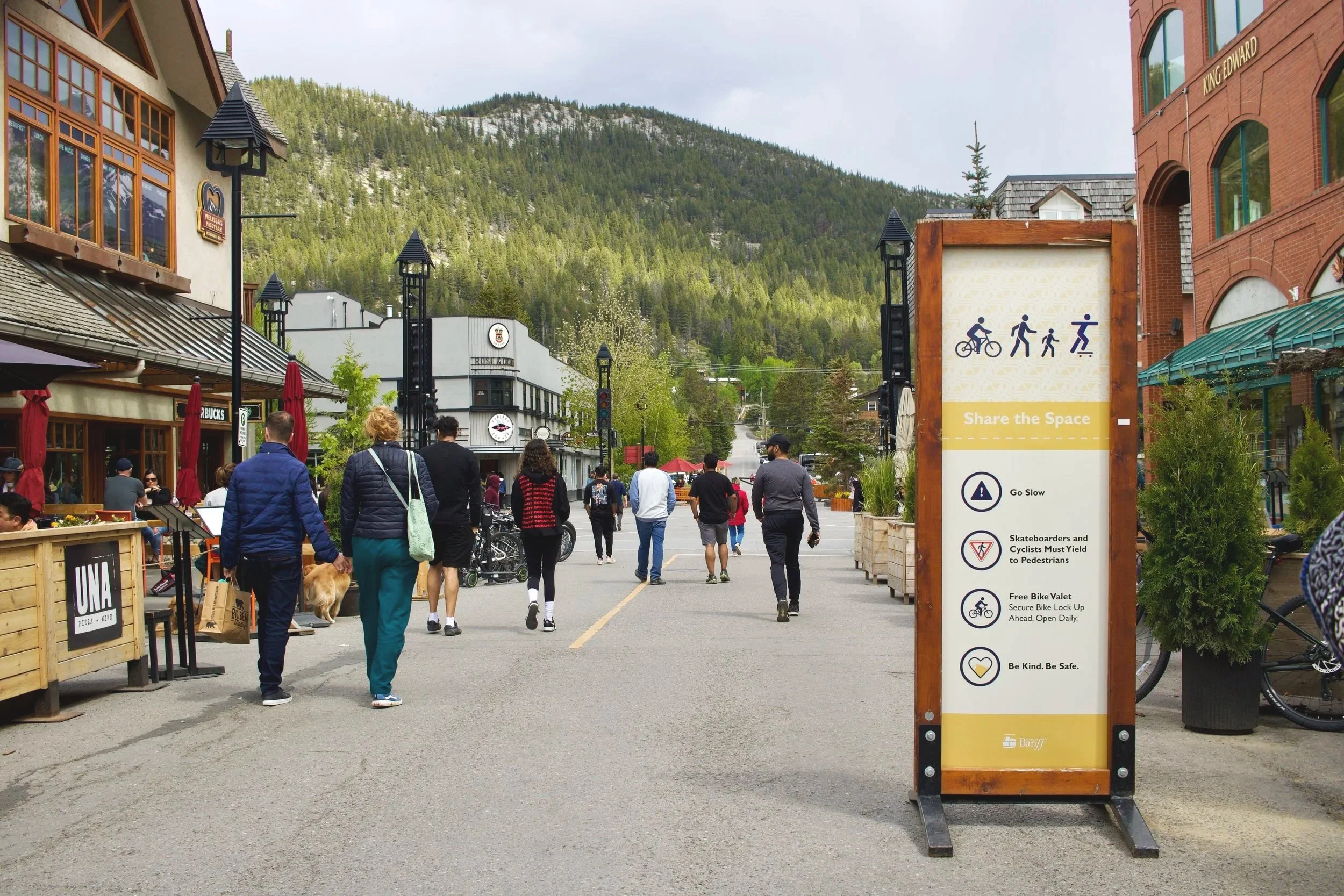
Sign with instructions on how to share the space on a pedestrianized street. Photo taken by Nicole Roach at Banff, Alberta.
The act of walking may sound simple. But the experience in cities is vastly different based on whether one feels safe, watched, or welcome. This is where the work of our organizations gets specific, and we start to see the overlaps less like a coincidence and more like a shared project.
Firdous: As an organization working to promote equitable cities for women and gender-diverse people, we at WIUC see overlaps with the work done at Jane’s Walk. How much of Jane Jacobs’ discussions on safety, mobility, and access to public space for all translates into organizing the festival and the walks?
Alejandra: Safety, mobility, and access to public space shape nearly every aspect of the Jane’s Walk festival. These are not abstract ideas for us. They directly influence whether people feel able to attend a walk or lead one in the first place. They affect where walks happen, how they are structured, and who feels welcome to participate.
At the planning stage, these considerations are built into how we support walk leaders. Each year, we host online and in-person workshops for people interested in leading a walk. During these ‘Walkshops’, as we call them, we encourage leaders to think carefully about routes, pacing, meeting points, terrain, transit access, and the social dynamics of being in public space. Because walk topics are proposed by participants and rooted in lived experience, many walks naturally explore issues such as safety, mobility, accessibility, inclusion, and more. The range of topics and perspectives continues to grow each year.
These same themes also shape the broader opportunities and challenges of the festival. One ongoing challenge is expanding the festival beyond the city core into suburban areas, where safety, mobility, and access can make it harder for walks to form organically. At the same time, when walks do take place, they clearly demonstrate the value of people-first spaces, pedestrian-friendly streets, multi-modal approaches to mobility, and creative interventions in public space, etc. Many walks allow participants to experience accessible parks, streets, and neighbourhoods firsthand, and to see clearly which solutions could make a positive difference in their neighbourhoods.
Finally, these ideas show up at the human scale. Over three days, strangers meet and are often introduced to new places and perspectives. Inclusion, dialogue, and care are temporarily woven into the social fabric of the city. Of course, this sense of shared safety and belonging is only possible because people choose to participate, get involved, and remain open to one another.
In that sense, Jane Jacobs’ discussions of safety, mobility, and access are present at every layer of the festival and in every walk.
Alejandra's point about safety and belonging being woven into the festival, even temporarily, is something we think about often at WiUC where conditions aren't temporary, but designed into the city itself.
Alejandra: From your perspective, what does it look like when women and gender diverse people truly feel they belong in public space, and what kinds of city design or community practices help make that possible?
Firdous: To tie it back to the experience of walking, a truly inclusive urban space would be one where women and gender diverse people are able to break free from behaviours we have internalized to keep ourselves safe — moving at a pace faster than we need to, avoiding eye contact, clutching our keys in our pockets, wearing headphones with no audio, keeping our loved ones on speed dial, rushing back home before it gets dark, and more.
From a pedestrian’s perspective, a non-sexist city would be one that is built on increased visibility so that we can see and be seen; values that are cornerstones of Jane Jacob’s phenomenal theory on “eyes on the street.” By designing cities where people can look out for each other, we create safer spaces for those who are the most vulnerable. And contrary to the polarized rhetoric of our times, a city built on these values is dependent on communities that foster empathy and collective action across our differences.
While this can seem challenging in practice, there are a few design interventions that feminist urbanists broadly agree on: better lighting, unobstructed sidewalks, accessible curbs, clear signage, more benches and spaces for pause and recreation, and activities or events that ensure the presence of people on the street at all hours. At WiUC, we observe that car-free streets benefit everyone — prioritizing the safety, comfort, and accessibility of pedestrians as well as cyclists while creating healthier cities for people of all ages and backgrounds.
“A truly inclusive urban space would be we break free from the behaviours we have internalized to keep ourselves safe — moving at a pace faster than we need to, avoiding eye contact, clutching our keys in our pockets, wearing headphones with no audio, keeping our loved ones on speed dial, rushing back home before it gets dark.”
Together, these perspectives recognize that safety in public space is not just an outcome — it's a design choice. Whether it's the route of a Jane's Walk or the layout of a city street, the same principles apply: visibility, accessibility, and the presence of people looking out for one another. When those conditions are met, more of us get to walk freely. When they're not, the city quietly tells some of us we don't belong.
On inclusion, the gaps, and the reasons for hope
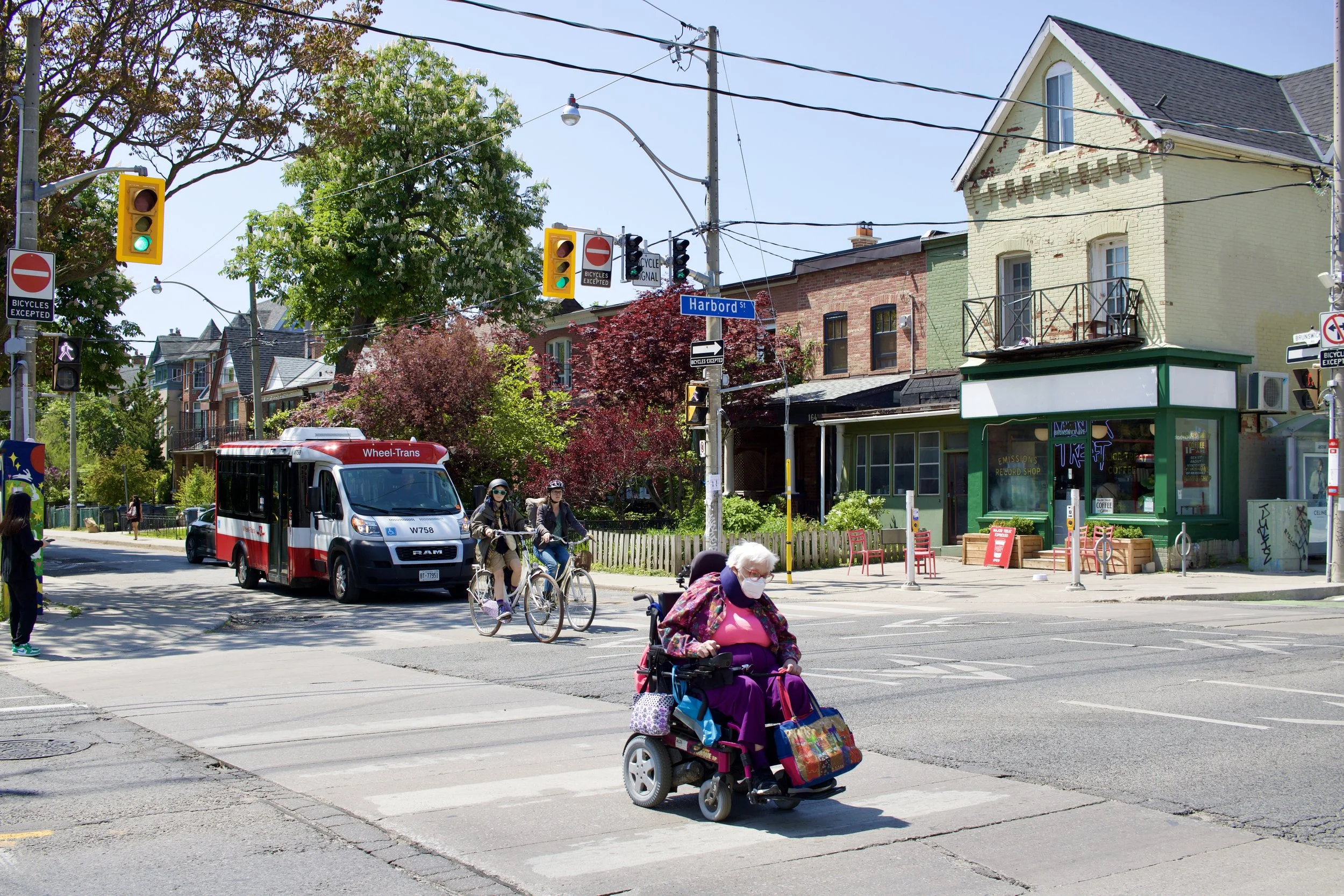
An older person crossing a street intersection, with paratransit service at the signal behind them. Photo taken by Nicole Roach at Toronto, ON.
Having worked in the non-profit sector, “inclusion” is one of those words that can lose its meaning through repetition, particularly in recent years. So, our conversation gets to the heart of what it takes to make space for the people most often left out of city-making, and about where the work is still unfinished.
Firdous: How do you ensure inclusive participation of marginalized groups (based on race, gender, age, disability, etc.) in leading/facilitating the walks?
Alejandra: We see our role as removing barriers and amplifying voices. We actively encourage walk leaders from communities that are often underrepresented in planning and city-building conversations, including women, gender-diverse people, racialized communities, youth, elders, and people with disabilities.
This commitment shows through targeted outreach, partnerships with community organizations, flexible ideas of what a walk can look like, and support throughout the planning process. We also listen closely to feedback and adapt each year based on what we hear.
For us, inclusion is not something to check off once. It is an ongoing practice that grows through relationships, care, and trust built over time.
It is also important to note that the Jane’s Walk Festival is a 100% volunteer-led effort, so our capacity is shaped by volunteer availability and community donations. Even so, one of our primary goals is to continue improving inclusion and accessibility as much as we can.
“For us, inclusion is not something to check off once. It is an ongoing practice that grows through relationships, care, and trust built over time.”
The framing of inclusion as an ongoing practice and not a box to check is something that resonates deeply with how we at WiUC approach our work too. It also raises the harder question of where cities, as a whole, are still falling short.
Alejandra: What gaps do you still see in how cities plan for safety, mobility, and care, particularly for women, gender diverse people, and other marginalized communities, and what gives you hope that these gaps can be addressed?
Firdous: One of the primary gaps we observe in urban planning and seek to address at WiUC is the lack of inclusive participation of women and gender diverse people in the decision-making processes that shape our cities. For too long, cities have been designed with a one-size-fits-all approach and we’re now left undoing the damage and spatial exclusion that results from decisions made by too few people at the table.
But we have hope that we can turn things around for the better. We believe that reclaiming our spaces in cities starts with gathering better data that actually reflects diverse voices and their unique lived experiences. Participatory walks around neighbourhoods and events like Jane’s Walk Festival are not only a celebration of the communities we’re a part of, but also powerful examples of how we can hear from people of different backgrounds and walks of life. We get to explore new spaces, meet new people, and talk about issues that matter to us in a way that online surveys just can’t capture, and have fun while we’re at it! These are ways of gathering information that genuinely involve the people we hope to design with.
Organizations like ours are in a unique position to shed light on spatial inequities in ways that are humane and rooted in reality, rather than conforming to age-old planning practices that only serve a few. We’re at a pivotal point in time where we see a growing interest in equity-based planning and design around the world, particularly in the domains of public transit and housing, and WiUC has the privilege of representing the Canadian context in this global conversation.
Across both responses, the same vision emerges: closing the gaps in our cities by rethinking who gets to be in the room, on the street, and on the route. Inclusion isn't a one-time achievement — it's an ongoing practice, sustained by the people who keep showing up. Whether through a festival walk or a research piece, the work is the same: making space for the voices that planning has too often overlooked.
Both of our organizations' believe that cities change when people show up, speak up, and walk together. Imperfect, ongoing, volunteer-fueled — but unmistakably moving.
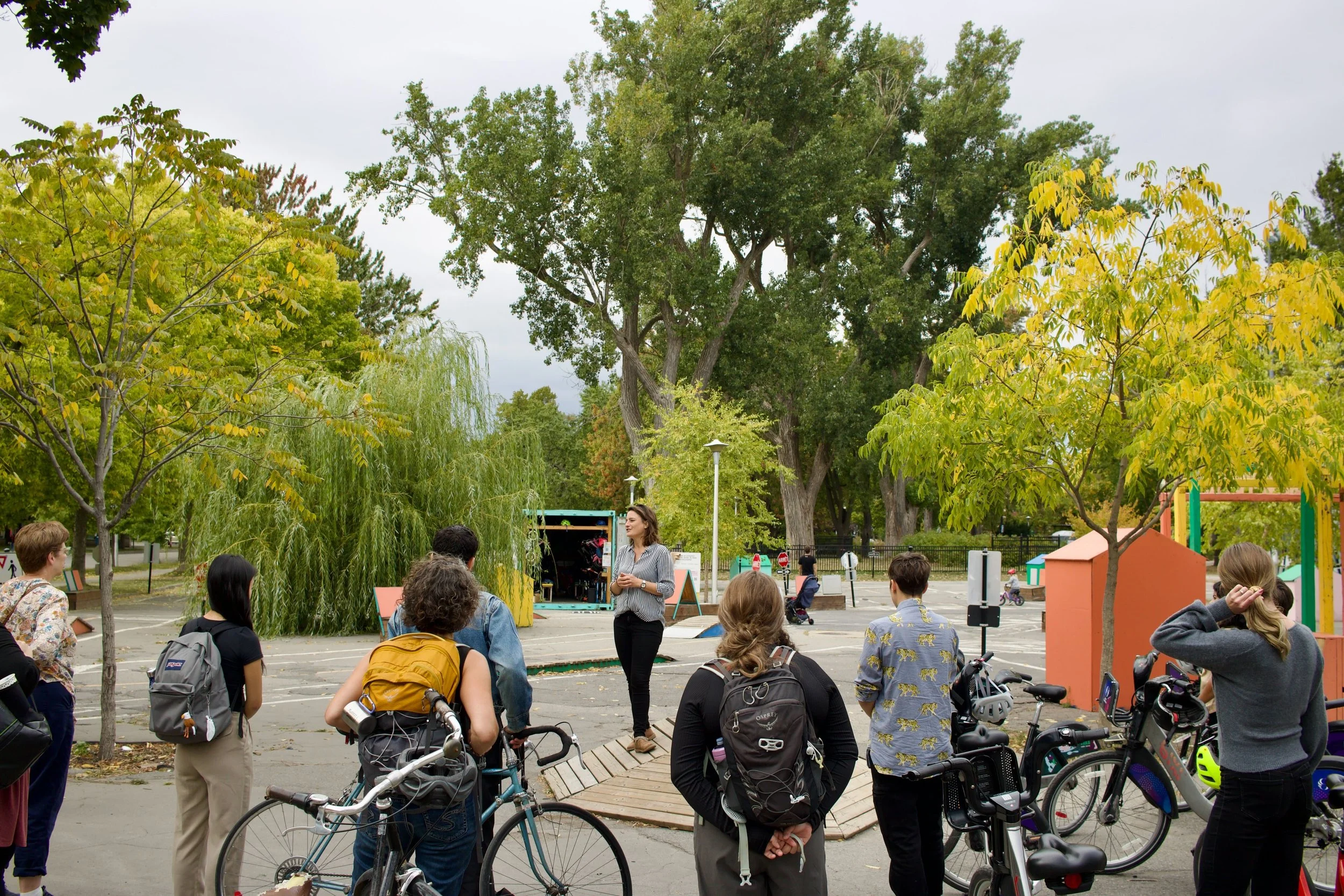
A guided walk in an educational cycling park. Photo taken by Nicole Roach for Green Communities Canada at Montréal, QC.
This conversation was with the Jane's Walk Toronto team, but the festival happens in cities across Canada and around the world. Wherever you are, there's likely a walk near you — or a neighbourhood waiting for one to be led.
Jane's Walk Festival runs May 1–3, 2026. You can find the full lineup of walks, plus information on how to attend or lead one, at www.JanesWalkTO.org.
For walks happening in other Canadian cities — including Montreal, Vancouver, Calgary, Ottawa, and more — visit www.JanesWalk.org, the festival's global website.
If this conversation resonated with you, we'd love for you to keep walking with us. Follow Women in Urbanism Canada at www.WomenInUrbanism.ca for more on feminist urbanism, public space, and the work of building cities that hold all of us.
Let’s walk together and shape our feminist cities.